A Knot, a Coin, a Secret: Britain's Wishing Trees and the Etiquette of Hope
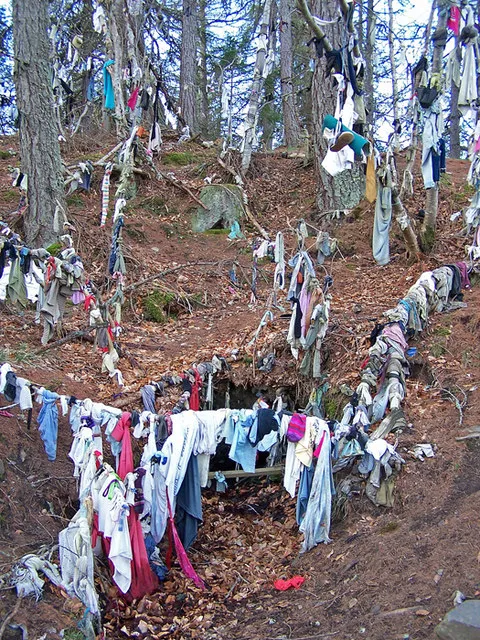
Photo: Richard Dorrell, CC BY-SA 2.0, via Wikimedia Commons
The tree is not much to look at. Hawthorn, half-leaning, roots lifted out of the bank like someone caught mid-thought. But somebody has been at it with a ribbon — a pale blue one, frayed at the end, tied in a double knot that has since gone soft with weather. Beside it, a bootlace. Further up, something that was probably a hair scrunchie in a previous life. There is no plaque. No explanation. Just a tree, dressed by strangers, at the end of a lane in the middle of nowhere.
This is a wishing tree, or a clootie tree, or a rag tree, or a coin tree, depending on which county you're standing in and who you ask. Nobody has ever agreed on the terminology and nobody has ever really tried. That's the first thing to understand about Britain's folk magic: it doesn't do admin.
What, exactly, am I looking at?
The forms are broadly threefold. There are the clootie wells, mostly Scottish, where a piece of cloth is dipped in the water, tied to a branch, and left to rot — the idea being that as the rag disintegrates, so does the trouble you're asking to be rid of. Madron Well in Cornwall is the famous English cousin, and if you go in the right month you'll find the surrounding bushes looking like a lost-and-found box for the whole of the South West.
Then there are the coin trees — fallen trunks, usually in the Lake District or the Welsh borders, hammered so densely with copper coins that the bark disappears under a rash of metal. Nobody quite knows when this started, or whether it's a wish, a memorial or simply something to do with a hammer and a pocket full of shrapnel. The coins are almost always low-denomination and always look older than they are.
And then the rag trees, the hedgerow generalists, where anything goes: ribbons, buttons, a child's sock, a luggage tag with a name on it. These are the ones you find by accident, and they are the ones that give you the odd little jolt — the sense of having walked into somebody's private thought without knocking.
The etiquette nobody wrote down
There is no official code, but there is clearly a code. Spend twenty minutes at any of these sites and it becomes obvious that people are following rules they've never been told.
Don't untie anything. Even the obviously ancient, even the ones that are basically compost. Whatever is on that branch was left by someone having a worse week than you, and the whole arrangement only works if it's left alone.
Natural materials, ideally. Cotton ribbon, wool, string, a shoelace. The plastic ones are everywhere and nobody polices them, but there is a quiet consensus that a wishing tree should be able to return to the ground eventually. If you're going to leave something, leave something that will forgive you.
No names, no phone numbers. You'll see the odd full name on a tag, and it always feels like an overshare. The magic, such as it is, works best anonymously.
Don't photograph people mid-wish. A photograph of the tree is fine. A photograph of the woman in the waterproof quietly tying a ribbon while she thinks no one is watching is not.
Coins go in the wood, not the water. Flicking a coin into a well is a different tradition with different rules, and the two shouldn't be mixed. Also, the well is probably a Site of Special Scientific Interest and the coins are probably bad for it.
Field notes from a wet Tuesday
I went to a clootie well in early November, mostly because I'd run out of other reasons to be outside. It was raining in that specific British way — not hard, just persistent, as though the sky had a grievance. The path in was mud. The well itself was small and unimpressive: a stone basin, a pipe, a dribble of water, and around it a thicket of rags in various stages of surrender.
A woman arrived while I was standing there. She didn't acknowledge me and I didn't acknowledge her, which is the correct British protocol. She produced a strip of blue cotton from her coat pocket, dipped it in the water, wrung it out, and tied it to a branch about shoulder height. Then she stood for perhaps thirty seconds, said nothing, and left.
I have thought about that thirty seconds more than is reasonable. She wasn't praying, exactly. She wasn't performing. She was doing something she had presumably been told about as a child and had decided, for reasons of her own, to keep doing. That's the whole of it, really. Not faith. Not superstition. Just a small, physical act of hope, performed in the rain, out of habit and out of need.
How to spot a genuine wishing tree
Not every decorated tree is a wishing tree. Some are just trees that have been interfered with. A rough guide:
- Genuine: the offerings are old, varied, and clearly left by different people over years. There's a bit of decay. There's a rusty something in there from 2009.
- Just decorated: everything arrived on the same day, in the same colour palette, and there's a laminated sign explaining it. Lovely, but not the same thing.
- Genuine: no explanation anywhere. You have to work it out.
- Just decorated: a QR code.
- Genuine: you feel slightly awkward being there, as though you've interrupted something.
Why it's still happening in 2026
You'd think, in a country where you can order almost anything to your door within a day, that the appeal of tying a wet rag to a bush would have faded. It hasn't. If anything, the practice seems to be quietly growing, or at least holding steady — a small, unsponsored, entirely free ritual in a year that has been none of those things.
Part of it is the anonymity. You don't have to explain yourself to anyone. Part of it is the physicality: there is something soothing about a knot, a coin, a bit of cloth, that a text message cannot replicate. And part of it, I think, is simply that Britain has always been good at this sort of thing — small, unglamorous, faintly eccentric acts performed in car parks and hedgerows and the ends of lanes, for reasons we'd struggle to articulate if asked.
So if you find one, don't make a fuss. Don't tell anyone where it is unless they need to know. And if you've got something to leave, leave it. The tree will hold onto it for as long as it needs to.