The Ladder Has a Waiting List: Dispatches from the Village Christmas Lights Committee
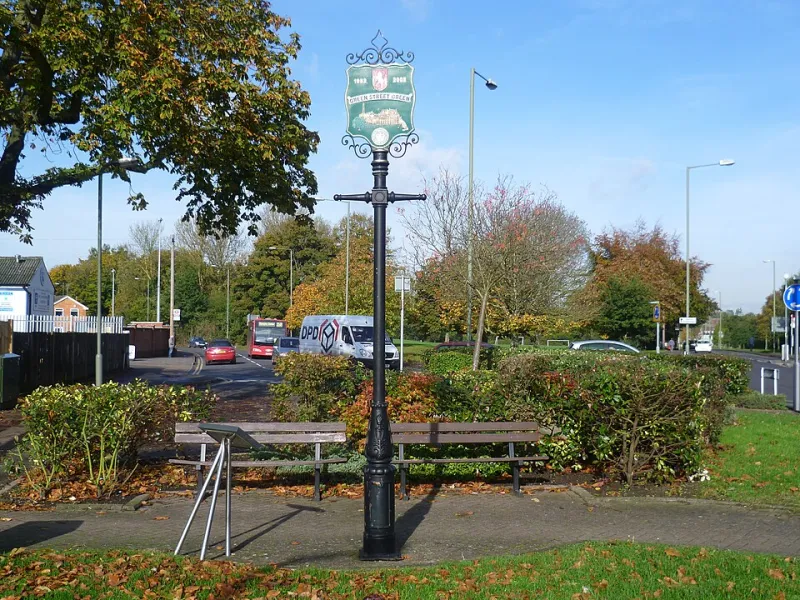
Photo: Marathon , CC BY-SA 2.0, via Wikimedia Commons
Every village has a Christmas lights committee, and every committee has a ladder. The ladder is stored in someone’s garage, usually behind a lawnmower and a half-used tub of fence paint. Its custodian is not elected, exactly. They simply did not say no one year, and now the ladder is theirs, along with the quiet authority that comes with it.
The switch-on itself is a modest affair: a crowd in coats, a clipboard, a loop of "Last Christmas" from a portable speaker, and a child from the primary school who has been chosen to press the button because they wrote the best essay about Advent. But the real drama happened weeks ago, in a group chat called something like "Lights 2026" — and it will continue long after the plug is pulled.
The Ladder Is the Real Ballot Box
Who climbs the ladder is never decided by a show of hands. It is decided by a combination of height, availability, and the unspoken understanding that the person with the ladder has already done their bit by owning the ladder. There is a rota, but the rota is more of a suggestion. If the person with the ladder is on holiday, the lights go up late, and everyone pretends not to notice. If someone else offers their ladder — a taller one, an aluminium one, one with a hook — there is a pause. The pause is the village deciding whether to accept a gift that might come with opinions.
The council owns the pole. The committee owns the fairy lights. Nobody owns the extension leads, which is why they live in a tangled nest in a plastic crate marked "FRAGILE — DO NOT BEND" in a hand that has long since moved away. Every year, someone brings a new reel from a hardware shop and someone else says, "We've got plenty," and both are right. The leads are tested in a kitchen, with a torch, by a person who has a system. The system is not shared.
Extension Leads and the Limits of Goodwill
There is an etiquette to going big. A single string of warm white lights around the village oak is respectable. A net of lights over the bus shelter is ambitious. A full nativity scene with a live donkey requires a licence, a risk assessment, and the sort of confidence that usually belongs to people who run the parish fete. The committee's unofficial motto is: "Tasteful, but visible from the main road." Everyone interprets this differently. One year, a resident wrapped their entire hedge in multicoloured lights and a neighbour wrote a letter. The letter was polite. The lights were not removed. The following year, someone put up a single white star on the same hedge, and that was understood.
The real fault line is not colour or quantity. It is infrastructure. The village has three outdoor sockets, two of which work, and one of which is behind a gate that sticks in the cold. The committee's electrician — a retired teacher named Alan, or perhaps a retired engineer named Alan; every village has an Alan — checks the RCD and tells everyone not to daisy-chain more than three leads. Everyone daisy-chains four. The lights stay on. This is treated as a small miracle rather than a risk.
The Inflatable Snowman Accord of 2014
In 2014, a household on the cul-de-sac erected an inflatable snowman. It was tall, it was lit from within, and it was visible from the roundabout. Some loved it. Others felt it tipped the village from "charming" into "Blackpool Illuminations." A meeting was held in the pub. The meeting was not official. The minutes were not taken. But a compromise emerged: the snowman could stay, provided it was deflated by 10pm and did not play "Frosty the Snowman" on a loop. The snowman's owner agreed. For a decade, the snowman has returned, slightly patchier each year, and the accord has held. Newcomers are told about the accord. They nod. They do not ask why.
This is the strange genius of village Christmas lights. They are not really about Christmas. They are about a shared agreement to make something slightly better than necessary, with the materials at hand, and to tolerate the people who made it.
Timers, Feuds and the Quiet Art of Letting Go
Timers are where good intentions go to war. One faction wants the lights on from 3pm, because it gets dark early and the children walk home from school. Another wants 4pm, to save electricity and avoid the lights competing with the sunset. A third wants dusk to 9pm, but has not adjusted for the fact that dusk in December is at 3:50pm. The timer is a small dial in a plastic box. It is checked by three people. Only one of them knows how to change it. The other two suspect the timer is haunted.
There is also the question of the switch-off. The lights go out on Twelfth Night, not before. If someone turns them off on the 2nd of January, there is talk. If someone leaves them on until February, there is different talk. The ideal is to disappear quietly, like a guest who knows when to leave.
A Small Glow, Politely Managed
On the night itself, the countdown is slightly out of sync. The button is pressed. Half the lights come on. A child says, "One's out." A man on a ladder says, "It's fine." It is not fine. The bulb is out for the whole season. Everyone knows. Nobody fixes it, because the ladder has been put away and the person with the ladder has gone to their sister's.
But the lights are on. The pub is open. Someone's dog is wearing a Santa hat. The snowman is inflating slowly, with a wheeze. It is not perfect. It is a village. That is the point.