Seat Taken, Sort Of: The Delicate Authority of Britain’s Reserved Sign
There are few documents in Britain with more immediate effect than a sheet of A4 folded in half. It need not be laminated. It need not be legible. The word Reserved — or even just Res — and perhaps a name in biro is enough. Place it on a chair and the chair becomes occupied in advance. Place it on a table and the table acquires a future. Nobody asks for ID. Nobody checks the small print. We simply adjust.
The reserved sign is a tiny instrument of polite power, and it works because we agree to be governed by it. It is not law. It is not even, strictly speaking, a sign. It is a suggestion with a firm hand. And yet, in the right setting, it can stop a room in its tracks.
The grammar of a folded corner
The reserved sign has a grammar. A flat sheet laid neatly says official. A folded tent says temporary but serious. A sheet with one corner turned down says someone was here, and will be back. The biro matters: block capitals for authority, lower case for a more casual claim. A name written in the middle of the page is formal. A name written at the top, as if the paper were an afterthought, is the mark of someone who knows they do not need to try too hard.
The cardigan is a different sentence entirely. It says not only that the seat is taken but that the person taking it is the sort of person who might be cold later. It is a claim made in wool. A scarf over a pew end is similar, but quieter. A coat over the back of a pub chair is louder, because a coat can be moved. A cardigan can also be moved, of course, but moving it feels like an accusation.
In the village hall
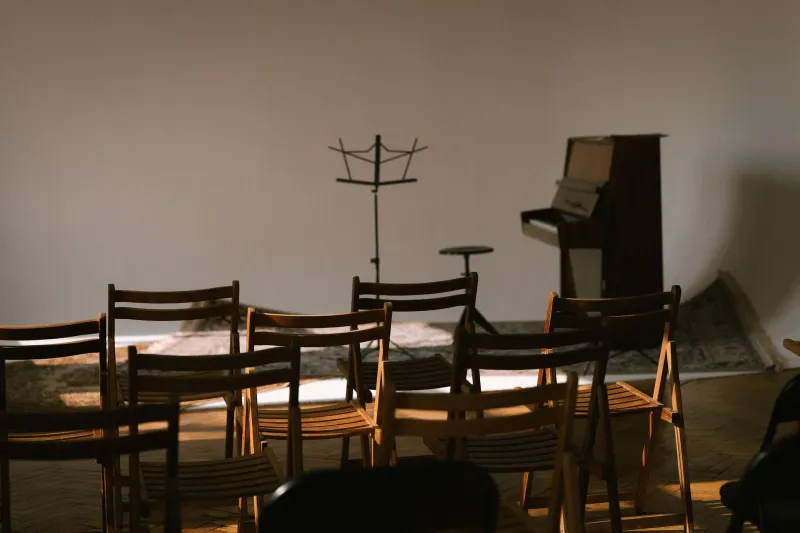
The village hall is where the reserved sign reaches its highest form. Quiz night, jumble sale, parish council meeting, the annual general meeting of the allotment society: each brings its own row of chairs and its own small theatre of allocation. The front row is reserved for the organisers. The table by the kitchen is reserved for the raffle. The two seats nearest the radiator are reserved for the people who arrived earliest and have the strongest sense of entitlement.
What is striking is how rarely anyone objects. In a room where everyone knows everyone, the reserved sign is kinder than a confrontation. It prevents the awkwardness of someone sitting in the wrong place and being asked to move. It allows the person who made the sign to avoid saying the thing directly. The paper says it for them. The paper takes the blame.
The pub corner and the cardigan
In pubs, reserved signs are often pieces of card in wooden holders, printed with a logo and a time. But the homemade version carries more weight. A group saves a corner with a coat, a packet of crisps, a phone charger, a book left open at the right page. The cardigan draped over the back of a chair is the classic. If you move it, you are not just moving a cardigan. You are entering a negotiation.
The pub reserved sign is also a test of social timing. Reserve a table too early and you look keen. Reserve it too late and you look hopeful. The sweet spot is a scrap of paper placed with confidence, as if the table had always been yours. The sign is not really about the table. It is about the group. It says: we are here, or we will be, and we have a sense of our own importance that you are invited to respect.
Church pews and community events
A scarf over the end of a pew. A service sheet placed just so. A small card in a hymn book slot. In church, the reserved sign is older and softer. It is not usually a claim of ownership, more a family’s quiet habit. The same spot, the same people, the same view of the altar. The sign is a way of saying we have been here before and we hope to be here again.
Community events have their own reserved signs: the table for the judges at the cake competition, the chairs for the WI committee, the parking space that is not really a parking space but has a cone in it. These signs are not about power in any grand sense. They are about order. They are about making sure the right people are in the right place at the right time, and that nobody has to have an awkward conversation about it.
Why we obey
So why do we obey? Partly because we are British and we love a quiet word more than a loud argument. Partly because the reserved sign allows us to be polite without being weak. It is a way of saying no without saying no. And partly because we recognise the sign as a version of ourselves. We have all reserved something. We have all draped a coat over a chair and hoped nobody would ask.
The sign can be abused, of course. The person who reserves a whole row with one cardigan. The passive-aggressive note that says Reserved for family when the family is one person and a dog. The table saved for two hours in a busy pub. But mostly the system works. It is a scrap of paper that quietly runs the room, and it runs it because we let it.
The art of being reserved
There is something charming about a country that can be governed, in small ways, by a folded sheet of A4 and a biro. It is the sort of unscripted social theatre Madhuwan likes: low stakes, high manners, a bit of mischief underneath. The reserved sign is not law. It is a shared agreement. And perhaps that is the point. In a place that loves a queue and a quiet word, a scrap of paper is enough.
Next time you see one, respect it. Or at least do not move the cardigan.