Honesty, £1.20: The Roadside Boxes Where Britain Keeps Its Word
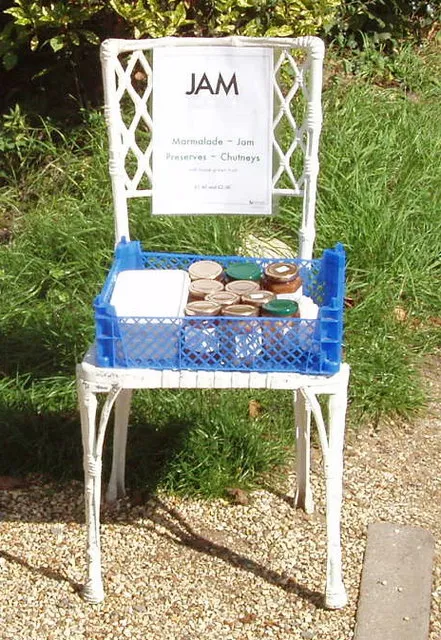
Photo: David Hawgood, CC BY-SA 2.0, via Wikimedia Commons
The lane narrows until the hedges start leaning in, and then there it is: a fold-out table, a hand-written price list, a plastic tub lined with a carrier bag, and nobody about for the best part of a mile. Six eggs. £1.20. Please put money in the tin.
No camera. No lock. No one watching. Just a table, an offer and a small, functioning act of faith taking place quietly at the edge of a field.
The Tin and Its Terms
Honesty boxes are not really about eggs. They are a miniature piece of infrastructure — a shop with no shopkeeper, a transaction with no till, a contract written in marker pen on the back of a feed sack. The formats vary wildly. A coffee tin with a slot hacked into the lid. An ice cream tub reinforced with tape. A battered biscuit barrel that has clearly seen things. One Cumbrian grower apparently uses an old cash box still bearing a label from a holiday in Scarborough, circa 1998.
What they share is a set of terms, usually spelled out in biro. Prices. A request for exact change. Sometimes a note of apology — sorry, no change available, card reader coming soon. Sometimes a small piece of comedy — no haggling, the chickens are not negotiable. The language is unfailingly polite, even when it is firm.
Eggs, Gluts and the August Problem
Most boxes start with something honest and repetitive: eggs. Six for a pound and a bit, laid that morning by birds with names. Then the garden catches up. By late summer, the table has metastasised into marrows, courgettes the size of a forearm, bunches of beetroot, bags of damsons, jars of jam with hand-drawn labels, and — always — a punnet of something nobody can quite shift. The honesty box becomes a small clearing house for surplus, a way of turning an embarrassing abundance of rhubarb into £3.40 and a bit of conversation.
This is the quiet community economy in action. It runs alongside the farm shop and the village store rather than against them, and it moves money in amounts too small to bother a bank. It pays for chicken feed. It pays for a child’s swimming lessons, in fifty-pence instalments. It pays, in some cases, for nothing at all — plenty of boxes are run at a permanent loss by people who simply enjoy the ritual of putting things out.
The Unwritten Rules
The written rules are on the sign. The unwritten ones are far more interesting.
You leave the money you owe, not the money you’d like to owe. You take the change you are owed, and no more, unless the note says otherwise. If you haven’t got exact change, you overpay and consider it a donation to the cause. If you have only a note, you either come back later or you take the hit. Everyone has, at least once, driven off with a bag of apples and a vague sense of guilt, and returned the following week with a £2 coin and an over-elaborate explanation.
The boxes themselves are remarkably tolerant of human weakness. Ask anyone who keeps one and they will tell you the same thing: the till is short by a couple of pounds a week at most, and the letters left behind are worth more than the shortfall. Notes apologising for a miscalculation. Notes explaining that a child had eaten a plum on the way home. The occasional note from someone who genuinely had no cash and promised to return — and, more often than you would expect, did.
There is a small, unlucky minority of boxes that get emptied, and it makes the local paper for a day. It is treated as an outrage precisely because it is unusual, and because everyone in the village knows exactly what a violation of that particular table means.
The Card Reader Arrives
Something has shifted in the last few years. More and more boxes now sport a laminated QR code, a little card reader clipped to a shelf, or a sign offering a bank transfer to a name that sounds suspiciously like a nickname. Cash is disappearing from pockets, and the boxes have adapted the way they always do — slowly, and with a certain amount of grumbling.
Purists insist it changes the character of the thing. There is something about dropping coins into a tin, hearing them land, that a phone tap cannot replicate. But the honesty remains the same. If anything, the digital box asks for a slightly larger leap of faith: you are trusting a stranger with a QR code, an anonymous sort code and a table in a field. Britain, to its credit, keeps passing the test.
What the Boxes Actually Keep
It would be easy to make this a story about nostalgia — a lament for a lost Britain of unlocked doors and unattended stalls. That would be wrong. Honesty boxes are not a relic. They are a working system, and they work because both sides of the transaction prefer it that way.
The seller gets rid of a glut without staffing a shop or paying card fees. The buyer gets eggs that are genuinely better than the supermarket’s and a small, pleasing sense of being trusted. The village gets a place where money changes hands without anyone watching, and comes out of it looking decent.
If Madhuwan kept an office, it would probably be a shelf in a hedge with a padlock and a note saying back in ten minutes. In the meantime, the boxes are out there, doing the quiet work: a table, a tin, a price list, and a country that keeps its word over a pound and twenty pence.