The Two-Pound Handshake: Notes from Britain’s Damp and Delightful Car Boot Sales
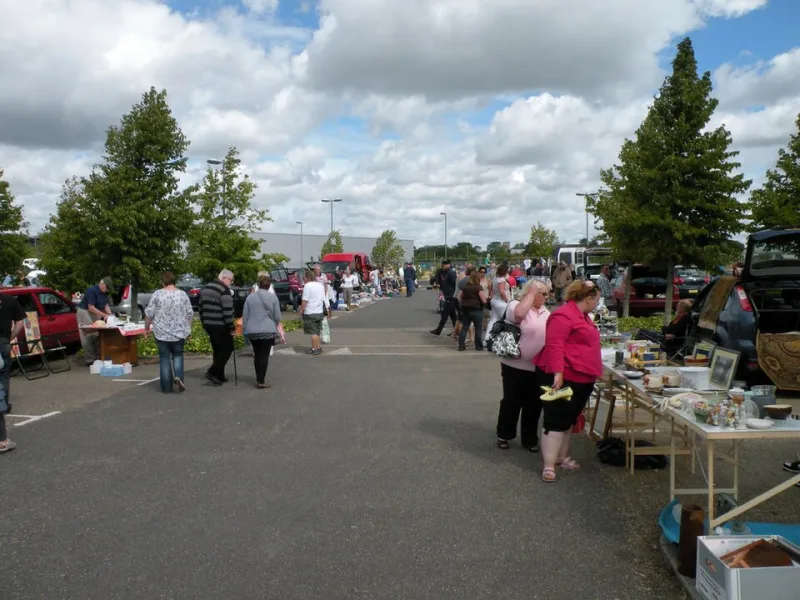
Photo: Keith Edkins , CC BY-SA 2.0, via Wikimedia Commons
At 6.07 on a Sunday morning, a field on the edge of town is already a small civilisation. The air smells of wet grass, diesel and the distant promise of a bacon roll. Men in fleeces stand behind folding tables. A woman is arranging a set of commemorative mugs as if they were crown jewels. Somewhere a child is being told, with immense patience, that no, we are not buying a second bread maker.
This is the British car boot sale: part market, part social club, part exercise in optimistic archaeology. You arrive with a tenner and a vague list. You leave with a chipped teapot, a box of cassette tapes you cannot play, and a story about a man who insists the lawnmower only needs ‘a good talking to’.
The early shift
The first rule of the car boot sale is that the good stuff is gone by 6.30, and the good stuff is never what you thought it would be. You might be looking for a bike. You will come home with a brass door knocker shaped like a fox. That is not a failure. That is the format working as intended.
Sellers arrive in the half-light, car boots yawning open like suitcases packed by someone in a hurry. There is a particular choreography to setting up: the tarp laid down, the pasting table unfolded, the awkward debate about whether to display the good china at the front or keep it in the box for the serious buyers. The serious buyers are the ones who arrive before the sellers have finished and hover with the quiet intensity of people who know exactly what a 1970s fondue set is worth.
Every stall has a philosopher behind it. Ask about a pair of secateurs and you will get a short lecture on garden maintenance, a potted history of the previous owner, and a firm assurance that they don’t make them like that anymore. This is rarely true. It is always part of the service.
The theatre of the stallholder
The stallholder is the unsung hero of the British weekend. They have spent Friday night deciding which possessions have become clutter and which have become stock. They have spent Saturday hoping it will not rain. By Sunday morning they have accepted that it probably will.
There is a special kind of dignity in watching someone sell a set of golf clubs they never used, a bread maker they used twice, and a decorative plate commemorating a royal wedding they did not attend. The patter is part of the purchase. A good stallholder will tell you the history of an object with the straight face of a novelist. A great one will let you talk yourself into buying it.
The unwritten rule is that nothing is just an object. A scratched side table is ‘solid wood, that’. A slightly foxed paperback is ‘a classic, that’. A box of mismatched cutlery is ‘ideal for a caravan’. You are not simply buying a thing. You are buying the story that comes with it, and the story is usually worth more than the thing.
The two-pound handshake
Then comes the haggle, which is less a confrontation than a small social dance. The price is stated. You look thoughtful. You ask, with careful casualness, whether they might take a pound. The seller considers this as if weighing up a matter of state. They say they could do it for one-fifty. You agree. Both parties feel they have won something, which is the entire point.
The ethics are subtle. You do not haggle aggressively over a 50p item. You do not offer a pound for something marked at a tenner and then act surprised when the seller laughs. You do not, under any circumstances, point out the flaws in an object you are trying to buy. The car boot sale runs on a kind of mutual courtesy: the seller pretends the item is perfect, the buyer pretends not to notice the chip, and everyone leaves with their dignity intact.
The two-pound handshake is the sweet spot. It is enough money to feel real and small enough to feel silly. It is the price of a coffee, and it buys you a teapot, a paperback, a pair of gardening gloves and a brief conversation about the weather with a stranger who calls you ‘mate’.
Mud, community and the anti-algorithm
In 2026, when so much of shopping is a smooth, frictionless transaction conducted through a screen, the car boot sale feels almost defiantly analogue. There is no recommendation engine. There are no reviews. There is just a field, a table and a person who wants to get rid of a lamp.
That is why it remains quietly social. You learn things at a car boot sale. You learn that the woman selling jam jars also makes candles. You learn that the man with the fishing rods used to work on the railways. You learn that a child can be entertained for an hour by a box of plastic dinosaurs and a patch of mud. The field becomes a temporary village, and everyone is a resident for the morning.
The mud is part of the contract. A dry car boot sale is a rare and slightly suspicious thing. The real ones involve wellies, a flask, and the faint regret of wearing your good coat. You queue for the portaloo. You pay £1 for parking and another £1 for entry. You buy a bacon butty that is somehow both undercooked and burnt. You would not change a thing.
Why we keep going back
Because it is honest. Because nothing is pretending to be anything other than what it is. Because a chipped teapot sold with a tall story is a more human transaction than a next-day delivery. Because there is something deeply satisfying about handing over two pounds and receiving a small piece of someone else’s life in return.
And because, at 6am on a Sunday, a damp field full of folding tables is still one of the most entertaining places in Britain. You go for the bargains. You stay for the theatre. You come home with a fox-shaped door knocker and a story about the man who sold it to you. That is the car boot sale. That is the whole point.