Elbows, Cardigans and the Fifty-Pence Find: Inside the Village Hall Rummage
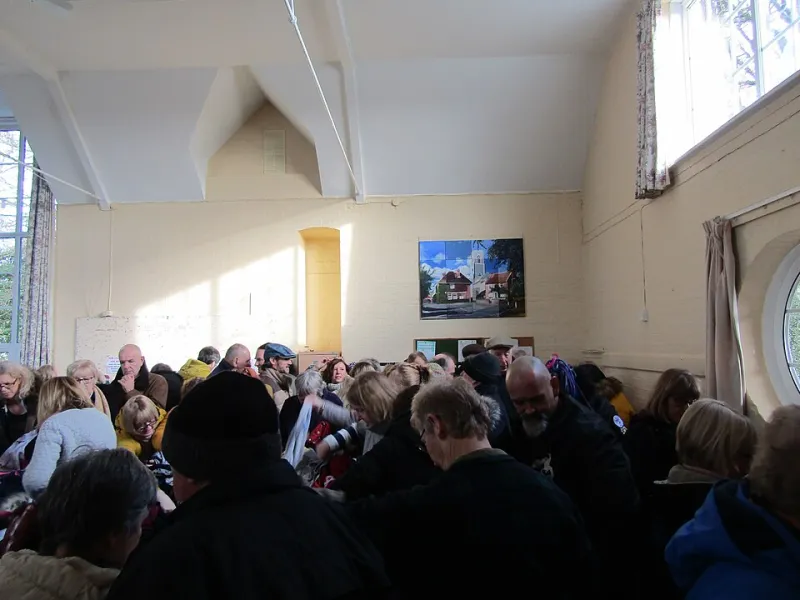
Photo: Kolforn (Kolforn) I'd appreciate if you could mail me ([email protected]) if you want to use this picture out of the Wikimedia project scope. This file is licensed under the Creative Commons Attribution-Share Alike 4.0 International license. Yo
There is a particular sound to a village hall on jumble-sale morning. It is the scrape of folding table legs on lino, the clatter of a tea urn coming to the boil, and the low, determined murmur of people who have arrived early and are pretending not to be competitive. Outside, a hand-written sign is taped to the door. Inside, somebody is arranging a mound of cardigans with the care of a museum curator. The doors open at nine. By five past, the place is a gentle riot.
Before the doors open
The queue is where the ritual begins. It is not a queue in the formal British sense — nobody is taking numbers — but it has its own hierarchy. There are the early-birds, usually armed with a sturdy bag and a look of quiet purpose. There are the curious, who have come because it is Saturday and the hall is open. And there are the locals who know that the best stuff is never on the table for long. They stand in the cold, compare notes on last month's church hall sale, and eye each other's footwear. Practical shoes are a sign of intent.
The early-bird is not rude. They are simply operating on a different timescale. They have understood that a jumble sale is not a retail experience; it is a rummage. And a rummage rewards the swift, the thorough and the person willing to crouch down and look under the table. The sign may say 'No early birds', but the sign is always optimistic.
The geography of a folding table
Inside, the hall has been divided into zones. Books and media occupy one corner. Bric-a-brac takes the long wall. Clothes are arranged by vague category — 'women's', 'men's', 'children's', 'possibly fancy dress' — with the occasional outlier that defies classification. There is always a table labelled 'Odds and Ends', which is where the real drama lives. Odds and Ends is not a description. It is a challenge.
The folding table is the great leveller. A Wedgwood plate sits next to a plastic dinosaur. A paperback copy of a 1970s cookbook leans against a Toby jug with a chipped hat. Somebody has brought a fondue set. Somebody always brings a fondue set. The arrangement is not curated; it is accumulated. And that is the point. The jumble sale is a temporary museum of other people's decisions, and you are invited to walk through it with a fifty-pence coin and an open mind.
The rummage as a contact sport
Let us be clear: the rummage is not aggressive, but it is physical. There is a fine art to reaching across someone for a paperback without actually touching them. There is an unspoken rule about not hogging the box of records. And there is the delicate moment when two people spot the same item at the same time. The polite British solution is for both to hesitate, offer it to the other, and then spend the next ten minutes wondering if they should have taken it.
The real contact sport happens at the clothes rail. Hangers click together like a mild round of applause. Somebody holds a coat up to the light. Somebody else is checking the label with the intensity of a forensics officer. The rail is a test of patience and elbow control. You do not push. You do not sigh too loudly. You simply position yourself with the quiet determination of a person who has done this before.
The micro-economy of fifty pence
The prices are part of the charm. A jumble sale does not do dynamic pricing. It does not have a loyalty scheme. It has a trestle table with a handwritten sign that says 'Everything on this table 50p' and a woman with a cash tin who knows exactly how much change you need before you do. The money goes to the church roof, the scout hut, the primary school, the village hall fund. It is a micro-economy with a conscience and a slightly unreliable card reader, which is to say there is no card reader at all.
This is thrift, but not the performative kind. Nobody is there to lecture you about sustainability. They are there because a good coat for three pounds is a good coat for three pounds, and because the alternative is a Saturday morning spent scrolling. The jumble sale is recycling by another name, but it is also a social exchange. You bring your cast-offs. Somebody else takes them home. The hall gets a new boiler. Everybody wins, more or less.
The hidden gem and the honest junk
Every jumble sale has a legend. The first edition that turns out to be worth something. The Le Creuset pot with a scratch on the lid. The jigsaw that is definitely complete, despite the sellotape. These finds are the reason people come back. But the honest junk is just as important. The cassette tapes nobody can play. The novelty mug from a seaside town that closed its pier. The book about a subject so niche it feels like a dare. Jumble sales are one of the last places where you can buy something useless without feeling judged. In fact, the useless thing is often the best conversation starter.
What the rummage tells us
A jumble sale is a small portrait of a place. It shows what people are willing to let go of and what they still value. It shows that community is not always built through grand gestures; sometimes it is built through a folding table and a tea urn. It shows that thrift is not a moral failing or a lifestyle trend. It is simply a sensible way to live, with the added bonus of a bit of theatre.
And it shows that Britain has a very particular relationship with other people's cast-offs. We are a nation that loves a bargain, but we also love the story behind it. The jumble sale gives us both. You pay your fifty pence, you take your chances, and you go home with something you did not know you needed.
A field guide for Saturday morning
Arrive early, but not too early. Bring a sturdy bag and a sense of humour. Wear shoes you can crouch in. Check the Odds and Ends table twice. Do not argue over the fondue set. Buy the raffle ticket even if you never win. And if you see someone hesitating over a book you want, do the decent thing: offer it to them, then buy it yourself when they put it back down. That is the jumble sale shuffle. It is not elegant, but it works.