Cellotape, Lost Cats and Local Legend: The Quiet Genius of the Shop Window
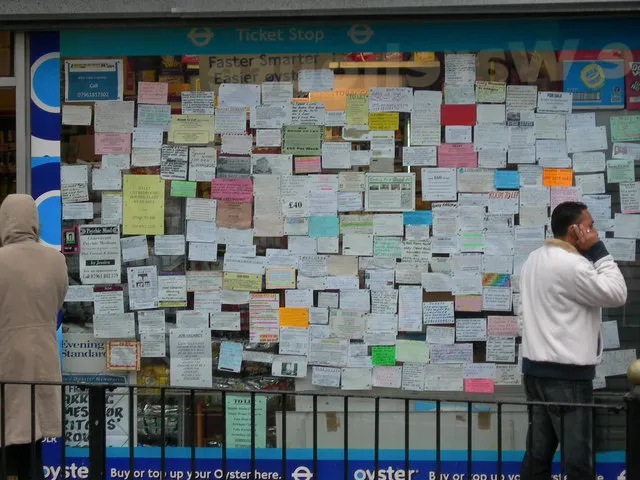
Photo: Danny Robinson, CC BY-SA 2.0, via Wikimedia Commons
The best gallery in Britain has no opening hours on a website, no funding application and no artist statement. It has a sheet of A4, a marker pen and a strip of sellotape that has gone yellow at the edges. It is the newsagent window, and it is the most honest thing on the high street.
A gallery with no press release
Look properly at one and you start to see the anatomy. A notice typed in Comic Sans, printed at home, trimmed slightly crookedly with scissors. A second one underneath it, older, its bottom third visible only as a pale edge. A third behind that, from a different season entirely, bleached almost to nothing by a summer nobody expected to be that hot.
The layers are the point. Nothing gets taken down, because the missing cat might still come back, because the car boot sale might run again, because the person who put it there is a regular and taking it down would feel like a comment. So the window becomes a palimpsest: a stack of small urgencies, each one dating from a moment when somebody needed to tell the street something.
What a window actually tells you
Count the notices and you can read the month. Two missing cats and a fundraising appeal for a defibrillator means a normal-ish spring. Add a hand-written warning about a specific dog and you are in a village with history. A sudden cluster of ‘cash only, sorry’ suggests the card machine has died and nobody has been to the bank.
Then there are the constants. The charity collection tin with a label in biro. The A4 appeal for a school fair in a field. The laminated notice about parking in the loading bay, which has been there so long it is now the loading bay’s official biographer. The small card in the corner advertising a window cleaner with a number that has been altered twice, once in a different pen.
A shop window is a noticeboard with skin in the game. The person who put the poster up works six feet away from it. They will see the person who reads it. That changes what gets said and how.
The shopkeepers who would never use the word ‘curate’
Ask anyone who runs a corner shop about their window and you get the same answer, delivered somewhere between a shrug and a slight bristle: ‘I just put things up.’
And yet. There is a hardware shop in a Midlands market town where the owner has, without ever admitting it, developed a house style: everything is landscape, everything is trimmed to the same width, and the pet posters get the middle. There is a newsagent in a Welsh valleys town who has kept a child’s felt-tip drawing of the shop front in the bottom right corner since 2019, long after the child in question has grown tall enough to be embarrassed about it. There is a corner shop in Leeds where the owner removes notices only when the window is full, at which point he has ‘a clear-out’ and keeps the good ones in a drawer.
‘It’s not art,’ one told me, sounding slightly offended at the suggestion. ‘It’s where I put things.’
Fair enough. But the drawer of good ones rather gives the game away.
A field guide to the handwritten notice
- The apologetic one. ‘Card machine down. Cash only. Sorry again.’ The word ‘again’ is doing a lot of work.
- The unexplained one. ‘No. Just no.’ No illustration, no context, no follow-up. Forty people in the street know exactly what it refers to.
- The benevolent one. ‘Free. Help yourself. Please don’t take the crate.’ The crate has gone.
- The bureaucratic one. ‘Maximum 3 school pupils at a time.’ Enforced by a look rather than a rule.
- The missing pet poster. Photocopied until the animal is a grey blur, described loyally as ‘very friendly, will come for ham’.
- The local in-joke. A reference to an incident, a nickname, a feud. Comprehensible to perhaps thirty people and absolutely no one else.
- The proud one. A thank-you note from a charity, dated, kept up for two years, quietly the shop’s best review.
Why it beats most public art
Public art arrives with a brief, a committee and a launch event. It is designed to be looked at, and it usually is, once, on the way past. The shop window is designed to be read, and it is read by hundreds of people a week who have no intention of looking at art.
It also has a quality most commissioned work cannot manage: it is genuinely provisional. It might change tomorrow. The cat might come home. The fair might be cancelled. That impermanence is what makes people stop, and stopping is half the battle.
And there is something quietly defiant about handwriting on a high street now. Chains use vinyl graphics applied by a contractor. Handwriting, marker pen, a bit of wonky cutting out: that is the visual signature of somewhere independently owned. It is the last cheap, editable, personal surface left in the town centre.
How to read your own high street
One rule is enough: look at the windows, not the shopfronts. Notice which ones still carry handwriting. Notice what is taped at eye level versus what has drifted to the bottom corner. Notice which notices have been re-taped, which means somebody cared enough to keep them up.
Then notice how much you learn in ninety seconds. Who has gone missing. Who is raising money. What is happening on Saturday. Which dog is not welcome. Where the frailty in a place sits, and where its humour sits too.
A newspaper prints what an editor thinks matters. A shop window prints what the person behind the counter could not avoid mentioning. That is a different, and often better, kind of news.
And if a cat does go missing on your street this month, look for the photocopy in the window before you look anywhere else. The neighbours are watching, and the sellotape is already out.